
Monday, 22 September 2025

Saturday, 13 September 2025
Saturday, 30 August 2025
Tuesday, 4 March 2025
Sunday, 22 September 2024
Friday, 13 September 2024
Wednesday, 31 July 2024
Wednesday, 3 May 2023
Monday, 1 May 2023
Sunday, 30 April 2023
Sunday, 13 March 2022
The Mass Vampire Hunt 1970

Friday 13th March 2022 marks the fifty-second anniversary of the largest vampire hunt ever to take place in the British Isles. It occurred at Highgate Cemetery on the evening of 13 March 1970, following reports in local and national newspapers, plus a television interview with various witnesses earlier on a programme called Today, Thames Television. Notwithstanding many amateur vampire hunters inflicting themselves on the cemetery with home-made stakes, crosses, garlic, holy water, but very little knowledge about how to deal with the suspected undead if they encountered it, I made an appeal on the Today programme at 6.00pm requesting the public not to get involved, nor put into jeopardy an investigation already in progress. Not everyone heeded my plea. Over the following weeks and months a wide variety of independent vampire hunters descended on the graveyard — only to be frightened off by its eerie atmosphere, and what they believed might have been the supernatural entity itself. Some were promptly arrested by police patrolling the area. None, however, caused any damage. I advised the public that a full-scale investigation was already taking place, and that individual efforts by those merely seeking thrills only served to endanger all. On the Today programme, 13 March 1970, I warned one self-styled vampire hunter in particular, who had appeared on the same programme as one of several witnesses, to leave things he did not understand alone. Apparently he had received “a horrible fright” a few weeks earlier when he allegedly caught sight of the vampire by the north gate of Highgate Cemetery and immediately wrote to his local newspaper about the experience, concluding with these words: “I have no knowledge in this field and I would be interested to hear if any other readers have seen anything of this nature.” (Letters to the Editor, Hampstead & Highgate Express, 6 February 1970).
In the following month the same individual revealed to the media that he had seen something at the north gate that was “evil” and that it “looked like it had been dead for a long time” (as told by him to Sandra Harris on the Today programme). I warned on the same programme that this man’s declared intention of staking the vampire alone and without the proper knowledge went “against my explicit wish for his own safety.”
The mass vampire hunt on the night itself was not attended by David Farrant who spent his time in the Prince of Wales pub before repairing home to Archway Road and the bunker of an acquaintance. The hunt went ahead, as chronicled in The Highgate Vampire book, and what was thought to be the vampire source and its resting place was discovered, along with empty coffins, in the catacombs.
I quite literally woke up and found myself famous. Yet it was a wholly unwanted celebrity.
Up until the end of the last century, notwithstanding one or two attempts to treat me in a lighthearted manner, I was received with impartiality and respect by film production companies, television and radio programmes, quality glossy magazines, including an appearance on the cover of The Sunday Times magazine, and others besides. As we entered the new century it became abundantly clear that people's beliefs, particularly belief in the supernatural, had fast begun to erode and become eclipsed by an aggressive form of atheism, often dressed up as something else, eg humanism etc. Interest in me did not lessen, however, but suddenly I was now, according to a new generation, see RationalWiki, and others of that ilk, "an unhinged British author." I was being painted as "unhinged" for one reason only: I was continuing to tell my story, but it no longer chimed with the atheistic, anti-everything considered supernatural, clique who dismiss all such things as fairy tales. My story now earned their opprobrium on a grand scale, and they were not slow to make their displeasure known.
“Fascinating in its subject matter and magnificent in the quality of its prose. Seán Manchester’s literary style is refreshingly reminiscent of the Gothic genre.”
~ Paul Spencer Vickers, Dept of English Literature, University College, London, England
“Seán Manchester is the most celebrated vampirologist of the twentieth century.”
~ Shaun Marin, reviewer and sub-editor, Uri Geller’s Encounters magazine, England
“A most interesting and useful addition to the literature of the subject.”
~ Reverend Basil Youdell, Literary Editor, Orthodox News, Christ the Saviour, Woolwich, England
“This book will certainly be read in a hundred years time, two hundred years time, three hundred years time ~ in short, for as long as mankind is interested in the supernatural. It has the most genuine power to grip. Once you have started to read it, it is virtually impossible to put it down.”
~ Lyndall Mack, Udolpho magazine, Chislehurst, England
Link to my personal recollection of the vampire hunt on the night of Friday 13th 1970:
https://www.youtube.com/watch?v=2hbubXOQCIk


Saturday, 12 March 2022
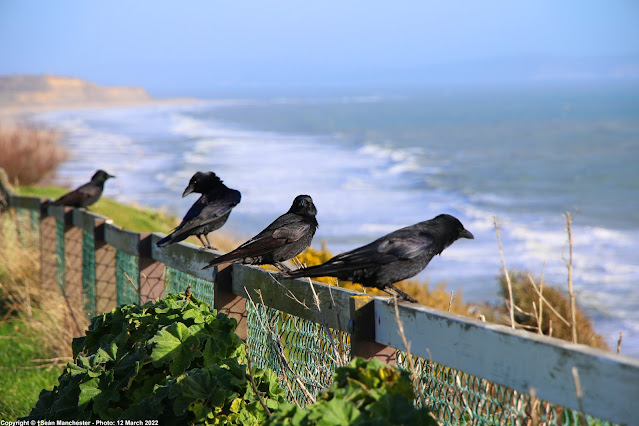
Some Secret Roost

And when the sea turns reddish blue
with the haze of evening
the crows lift off in ebony formation
head toward some secret roost
where they blend into the night.



Wednesday, 2 March 2022
Bill Haley and his Comets


Bill Haley and his Comets were the first Rock 'n' Roll band I was triggered by. The lads at school had been going on and on about this outfit, and I was excited to learn why. Roy Haslop pronounced the lead singer's name as though it were one word, ie billaley, which sort of added to the confusion. Hence I went into Star Records on the corner of Drayton Park and Holloway Road to listen to See You Later Alligator on a 78rpm record in one of the booths provided. I could not contain my excitement. I would soon be telling Steve Howe who was instantly mesmerised by this new music called Rock 'n' Roll. We were still at school, of course, but that didn't stop me acquiring a sax to play with my chums.
I was struck by Rudy Pompilli's instrumental Rudy's Rock which number would be my first public performance before an audience. Steve Howe was there at the front, transfixed by our lead guitarist, John "Yoss" Baker, who was joined by Ken Winchester on rhythm guitar and Barry Reid on vocals. I can't remember the bass player's or drummer's name, but they were red hot. The whole joint was jiving, and it marked my beginning as a saxophonist. The watercolour shows me playing Rudy's Rock.


Thursday, 24 February 2022
After the Storm
This might more accurately be titled After the Storms; because we had at least three, one of them registering 122 mile winds at the Needles, IOW, which is too close for comfort, and an all time record.

The storm has passed; its fury spent
No more for me the punishment
Of darkened view; of helpless terror
Of knowing my time was spent in error
The storm has passed; it could not win
Though I do know that I have sin
The storm has passed; it did not break
That which it sought to unmake
Helpless in the face of its might
Living through one long night
But now, my love, I stand with you
And watch the bright new day anew
The storm has passed; it failed to shake
I could not let it dictate
Its fury did rend my tortured soul
Its claws now dragged back to hole
But now the sun does shine on earth
And once again I feel my worth
The storm has passed; failed; in defeat
And in its place there now stands peace
No place for me on gallows hill
Set down for me is life’s pure thrill
This wind of change blows pure and clear
And music I can once more hear

Tuesday, 22 February 2022
Little Richard

My best friend during the explosive rock 'n' roll era was Steve Howe who went on to become a guitarist of some note in his own right. We really enjoyed all the emerging bands and artistes in the 1950s, but head and shoulders above all of them was the phenomenon known as Little Richard.
Born Richard Wayne Penniman on 5 December 1932, in Macon, Georgia, Little Richard was the third of twelve children. His father, Bud, was a stern man who made his living selling moonshine and didn’t do much to hide his disdain for his son’s flamboyant style. At the age of thirteen, Little Richard was ordered to move out of the family home, and his relationship with his father was never repaired. When Little Richard was nineteen, his father was shot dead outside a local bar.
The childhood that Little Richard did manage to have was largely shaped by the church. Two of his uncles, as well as his grandfather, were preachers, and Little Richard was involved with the church as much as anyone in his family, singing gospel and eventually learning to play the piano.
Upon moving out of his family’s home, Little Richard was taken in by a white family who owned a club in Macon, where he eventually began performing and honing his talent.
In 1951 Little Richard caught his first major break when a performance at an Atlanta radio station yielded a record contract with RCA. But with a repertoire of mainly mild blues numbers that masked the searing vocals and piano that would come to define his rock music, his career failed to take off as he had hoped it would.
In 1955, Little Richard hooked up with Specialty Records producer Art Rupe, who had been hunting for a piano-pounding frontman to lead a group of musicians in New Orleans. In September, Little Richard stepped into the recording studio and pumped out “Tutti Frutti,” an instant Billboard hit which reached Number One. Over the next year and a half, the musician churned out several more rock 'n' roll hits, including “Long Tall Sally,” “Good Golly Miss Molly,” and “Send Me Some Lovin’.” With his blood-pumping piano playing and suggestive lyrics, Little Richard, along with the likes of Elvis Presley and Jerry Lee Lewis, established rock 'n' roll as a real musical form which would inspire others.


In addition to his records, Little Richard appeared in several early rock films, such as Don’t Knock the Rock (1956), The Girl Can’t Help It (1957) and Mister Rock ‘n’ Roll (1957). As far as Steve and I were concerned, nobody had the explosive energy, powerful delivery and total madness of Little Richard.


In 1986 Little Richard was one of the ten original inductees into the Rock 'n' Roll Hall of Fame. He was a recipient of a Lifetime Achievement Award from the National Academy of Recording Arts and Sciences in 1993, and a year later the Rhythm & Blues Foundation honoured him with its prestigious Pioneer Award.
In later years, the once-dynamic performer retreated from the concert stage. He fell ill during a show in Washington, DC, during the summer of 2012. The following September, Little Richard suffered a heart attack. He described the incident to Cee Lo Green during an interview in Atlanta: "The other night, I didn’t know I was having a heart attack. I was coughing, and my right arm was aching."
The singer took baby aspirin, which his doctor credited with saving his life. The deeply religious music icon attributed his survival to a higher power: "Jesus had something for me. He brought me through."
Little Richard's agent confirmed that the singer passed away on 9 May 2020, in Nashville, Tennessee, from bone cancer.
I miss Little Richard enormously, and still play his records all the time, as I am sure Steve Howe does.


Saturday, 8 May 2021


Friday, 7 May 2021
For Stephen Howe
An expressionist tribute to my old chum Steve Howe of YES fame. I employed a Gibson and a Fender for its execution. The avant-garde is an area, perhaps the only area, Stephen has avoided on guitar.

Tuesday, 4 May 2021
Peter Cushing Lived in Whitstable
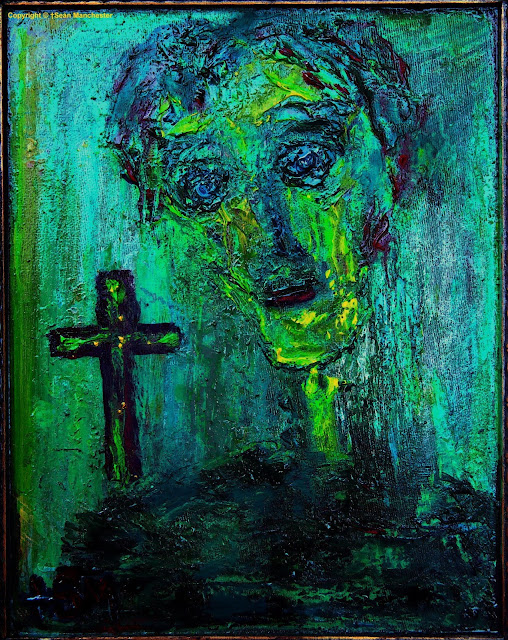
Portrait of Peter Cushing (oil on canvas) by †Seán Manchester


Subscribe to:
Posts (Atom)

-
 “There is no such thing as bad publicity except your own obituary.” — Brendan Behan In 2019, the Angel of Death struck, and three...
-
My best friend during the explosive rock 'n' roll era was Steve Howe who went on to become a guitarist of some note in his own rig...
-
 Jean Simmons was born on 31 January 1929 in Islington, London, a place I was once very familiar with in my earlier years. It was where ...
